A First Visit to a Japanese Tea Gathering: What to Notice
A first visit to a Japanese tea gathering can feel hard to read. Learn what to notice, how to follow the host’s cues and prepare without over-rehearsing.
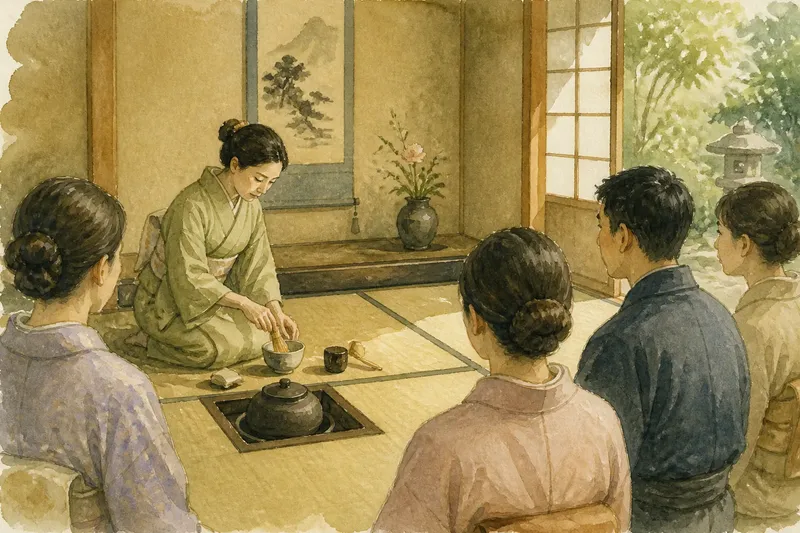
The common mistake at a first Japanese tea gathering is trying to memorise rules before noticing what is happening. It can make a quiet occasion feel like a test, leaving you unsure where to look or when to move. Follow the sequence, watch how objects are handled, and let the host or organiser guide you.
Gatherings vary by school, setting, occasion and guests. Some are formal; others are relaxed. Rather than judging the event against one ideal, pay attention to the choices being made in that particular room.
Follow the sequence instead of hunting for hidden rules
A gathering usually has a shape: guests arrive, the host prepares, tea is served, and the occasion comes to a close. Details and order differ. Notice what the host does, then allow a moment for other guests to respond.
At a formal gathering, you may be asked to wait in a designated area, enter the tea room in turn, or take a particular seat. Follow the host’s directions and the lead of guests who clearly know the arrangement. If you cannot tell whether to move, pause rather than crossing the room to investigate.
Pay attention to transitions. A change in the host’s movements may signal a shift from preparing the room to preparing tea, or from serving a guest to attending to the utensils. You do not need to name every gesture. Notice how each action makes space for the next.
Notice what the utensils are doing
A tea bowl, whisk, scoop, cloth and kettle shape the host’s movements and the order of the gathering. Watch where each object rests, how it is picked up, and whether it is turned or presented. This handling shows attention to both the objects and the people present.
Some objects may be discussed or passed for closer viewing; others remain in use. Do not reach for an utensil because it looks available. Wait until the host indicates that guests may examine it, then follow directions for holding or returning it. Think of a place setting at someone else’s table: noticing the arrangement is welcome, but rearranging it without invitation is not.
The room is part of the arrangement, too. A flower, hanging scroll, hearth or seasonal detail may draw attention, but its meaning is not always explained. Notice it without assuming that every item carries a fixed message.
Keep attention shared rather than performative
Focusing too intently on one detail can make you miss the gathering’s shared rhythm. Look at the host, the guest receiving tea, and the other guests in turn. Their pauses and changes of posture can help you tell when to listen, respond or remain still.
Speak softly if conversation is appropriate, and listen before asking about an object or gesture. A brief question at a natural pause may be welcome; running commentary can draw attention away from the host’s work. If you are unsure whether a response is expected, follow the other guests rather than filling the silence.
Say you are invited to a gathering where the host sets out a bowl and prepares tea while another guest receives the first serving. You notice that others wait until that person has settled before turning their attention to the bowl. If you follow their pause, you can share the room’s attention without knowing the name of every gesture.
Prepare for a Japanese tea gathering without over-rehearsing
Before attending, ask the organiser about practical expectations: arrival, clothing, footwear, seating, photography and whether guests may handle utensils. For a formal gathering, the organiser may explain school-specific etiquette. Follow those directions rather than relying on a rule remembered from another setting.
Choose clothing that lets you sit and move easily, and keep accessories unobtrusive if you expect to handle a bowl. Arrive with time to settle, but do not enter a room or touch an object before you are invited. If a cultural centre, school or host family arranged the visit, ask the person who organised it about local expectations.
What should you do if you lose track of the order?
Should you copy the guest beside you?
Use another guest’s actions as a quiet cue, not as proof that every setting follows the same rule. If the host has given a different instruction, follow that instead.
Is it rude to ask what happens next?
A discreet question to the host or organiser before the gathering can prevent uncertainty during a formal moment. If you are already in the room, wait for a pause and ask briefly only when you need guidance.
What if you make a small mistake?
Stop, avoid drawing extra attention to it, and let the host or another guest indicate what to do. A calm response is generally more helpful than a long apology that interrupts the occasion.
Can you take photographs?
Do not assume photography is allowed, especially during preparation or service. Ask the organiser beforehand and keep your phone away unless permission is clearly given.
Respond to tea and sweets with care
Tea may be accompanied by a sweet, with a particular way guests are invited to receive or eat it. Watch for the host’s explanation or follow the sequence used by other guests. If you have a dietary need, tell the organiser in advance rather than waiting until food is served.
When tea is offered, take it as directed and handle the bowl carefully. The host may show how to lift or turn it, but conventions vary. If no instruction is given and you are uncertain, a quiet glance at the guest who has just been served can help. Avoid inspecting the bowl conspicuously or delaying the next part of the gathering.
At your first Japanese tea gathering, give yourself permission to notice more than you can explain. Follow the sequence, watch how objects guide attention, and respond to the people in the room. If a detail remains unclear, remember it and ask about it afterwards, when the host has time to answer.