The Samurai Were Never One Unchanging Type
The samurai changed with Japan’s political order. Learn how to read their shifting roles and later portrayals without treating one image as timeless.
The most common mistake in reading about samurai is to treat the armoured warrior, the disciplined swordsman and the cultured retainer as one timeless person. That shortcut obscures history: a source about a medieval mounted fighter may tell you little about a later town-dwelling official, even when both are called samurai. The samurai were not a single, unchanging type; the useful question is which period, duty and portrayal you are looking at.
Think of the word as a coat worn for different jobs over time. The coat remains recognisable, but its cut and use change. A careful reader can sort a samurai account by asking whether it describes a warrior’s work, a place in a political hierarchy, a moral ideal, or a later story about the past. These layers overlap, but they are not interchangeable.
Start with the role described in the source
Early samurai were associated with service to powerful households and the work of armed retainers. Their duties were not limited to fighting: loyalty, protection, administration and the management of local authority could all matter. Their position depended on relationships and political arrangements, rather than membership in a uniform national profession with the same tasks everywhere.
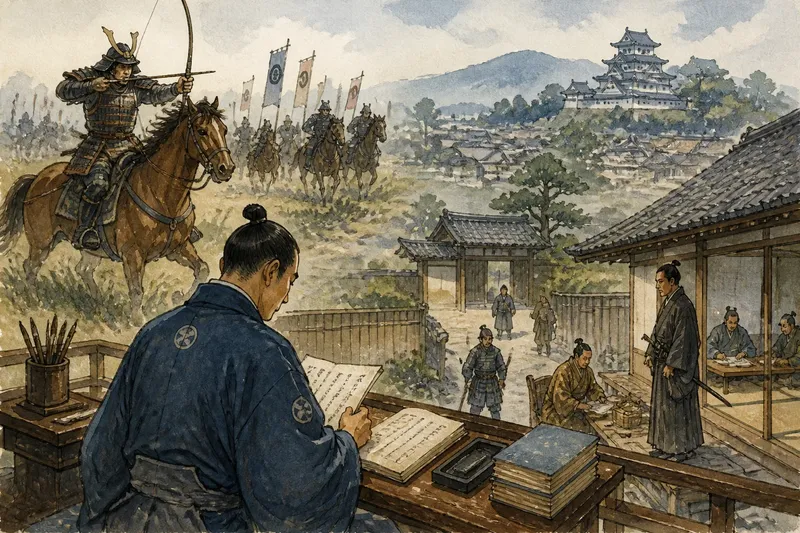
In accounts of medieval conflict, mounted archery, landholding and service to a lord may matter more than the later image of a swordsman alone. A source that emphasises a warrior’s horse, bow or obligations presents a different setting from one centred on a sword-bearing official. Neither image needs to be dismissed; each needs to be placed.
If a passage seems to define all samurai by combat, ask what the person is actually doing in that scene. Is the source concerned with a battle, a dispute over land, a household’s administration or the display of rank? The answer helps identify what the text can support and what it leaves unsaid.
Read battlefield accounts as evidence of particular service
Warfare shaped the reputation of samurai, but it did not make every samurai’s daily life identical. Military service could involve different weapons, duties and social relationships. The popular picture of an individual swordsman facing an opponent in a formal duel is especially narrow when used as a stand-in for all armed service.
Armour and weapons make more sense as equipment within a situation, not as a complete description of a person’s character. A bow suggests one kind of martial practice; a sword might serve as a weapon, a badge of standing or both, depending on context. An object can reveal something about the scene without proving that every member of the class lived by the same code or fought in the same way.
Say you are comparing two accounts: one describes a retainer riding out with a bow, while another portrays a swordsman guarding a lord’s residence. The first account foregrounds mounted service; the second shows a different duty in a different setting. Rather than choosing which is the “real” samurai, note who wrote each account and what each was meant to convey.
Separate social status from a fixed occupation
As political arrangements changed, samurai identity became more closely tied to inherited status and service within a governing order. In periods of relative peace, many samurai performed administrative, policing or household duties. Military readiness remained part of their standing, yet it did not mean that every person spent each day on a battlefield.
This distinction matters when a source depicts a samurai as a bureaucrat or official. It is not evidence that the figure has ceased to be a samurai, nor does it make the earlier warrior role a fiction. The social position persisted while the work attached to it shifted. A title can outlast the everyday conditions that first made it familiar.
Accounts may also describe samurai facing financial pressure or uncertain duties. Such details complicate any simple equation between status and wealth, or between rank and constant authority. The class was internally varied, and the experience of a high-ranking retainer could differ sharply from that of someone with fewer resources or weaker connections.
Distinguish conduct from later ideals
Stories of loyalty, courage and self-discipline shape how people imagine samurai. These values mattered in particular settings, but the familiar idea of one complete, timeless “samurai code” can turn changing ethical discussions into a single rulebook. Writers in different periods emphasised different virtues, and ideals could be used to praise, criticise or instruct.
When a source presents an exemplary warrior, ask what kind of example it offers. A memorial account may honour a person; a moral text may set out conduct to admire; a dramatic story may heighten conflict for an audience. Those purposes do not make the material useless. They do mean that a polished ideal should not automatically be read as a neutral record of ordinary behaviour.
Notice, too, when a later writer looks backwards from a more peaceful society. Discipline and martial courage could then become symbols through which people discussed political order, duty or personal conduct. The portrayal tells us about the writer’s concerns as well as the past being described.
Choose a source-reading lens that fits your question
Before settling on an interpretation, identify what the source says and what it asks you to infer. These checks help separate a specific scene from a broad claim about samurai history.
- Check whether the passage names a period or political setting; if it does, interpret the role in that context, and if it does not, avoid assigning it to a particular era without other evidence.
- Check what the person is doing, such as fighting, administering a household or guarding a residence; if an action is clear, describe that duty, and if it is not, do not infer an occupation from clothing alone.
- Check whether the source identifies rank, household ties or a lord; if it does, use those relationships to explain status, and if it does not, leave the person’s precise position open.
- Check whether a weapon is shown or mentioned; if it is, use it as evidence about that scene, and if it is not, do not assume the person’s work was unarmed or exclusively martial.
- Check whether the wording praises or condemns conduct; if it does, treat that judgement as the author’s view, and if it does not, avoid adding a moral lesson the source never states.
- Check whether the work is a record, a moral text, a performance or a later story; if its purpose is clear, weigh claims accordingly, and if it is uncertain, describe the portrayal without treating it as a neutral account.
For a worked reading, imagine a fictional passage that says, “A retainer held the household accounts and kept a sword at his side.” The starting details are a household duty and a weapon; the author and period are unknown. First, separate the action from the object: the clear task is keeping accounts. Next, note that the sword indicates an armed or status-related association but does not prove the retainer fought in that scene. Finally, leave the date and rank undecided because the passage supplies neither. The resulting reading is modest but useful: this portrayal joins administrative work with a martial sign, while its wider historical setting remains unresolved.
What should you ask when reading samurai portrayals?
What should I focus on in a battle account?
Focus on the named duties, weapons, relationships and circumstances in the passage. Treat it as evidence about the conflict and people it describes, not as a portrait of every samurai across all periods.
How should I read a samurai serving as an official?
Read the figure as someone whose social standing and work belong to a particular political order. Administrative service does not contradict a history of military identity; it shows how the role could change when the conditions of rule changed.
Does a text about loyalty describe what samurai always did?
Not by itself. First decide whether the text records conduct, praises an ideal or argues for a standard, then compare its claims with the situation it addresses.
What if a film or novel shows a familiar swordsman?
Enjoy the character as a portrayal, while keeping the work’s period, genre and audience in view. A dramatic image can draw on historical material without serving as a complete account of samurai life.
Read later portrayals as history in their own right
The samurai image continued to change after the social role itself had been transformed. Later writing, performance and popular entertainment selected certain features—swords, loyalty, restraint or dramatic sacrifice—and gave them new emphasis. A memorable portrayal may combine details from different periods or arrange them to suit a story’s moral and emotional purpose.
That does not make later portrayals worthless for historical understanding. They can show how people in a later era imagined the warrior past, what qualities they admired and which conflicts they found compelling. The crucial distinction is between using a work as evidence about its own time and treating it as a direct window onto the people it depicts.
For a film, novel or illustrated story, note the choices it makes. Does it centre on a single hero, a household, a political crisis or a changing social order? Does it make swordsmanship the main sign of identity? Those choices tell you what kind of samurai image the work wants to create, not necessarily how broadly that image applied.
Match the source to your purpose
If you want to understand warfare, begin with details of service and conflict in the source. For social history, look for rank, household ties, duties and material circumstances. When studying ideals, distinguish advice and praise from descriptions of ordinary conduct. When exploring a later portrayal, ask what its creators selected from the past and what they changed.
These lenses need not compete. A single source may reveal a person’s work, a society’s hierarchy and an ideal being promoted at once. The task is to keep those claims at the right scale. One character can illuminate a particular situation; one text cannot settle what every samurai believed or did.
For a quick reading habit, underline words that identify action, status and judgement. “Served”, “held” or “administered” may point to a role; “honourable” or “loyal” may signal an evaluation. Then ask whether the author is describing, praising or imagining. This separation prevents a vivid scene from silently becoming a universal rule.
Keep the changing role visible
The samurai were neither merely battlefield fighters nor merely figures in later legend. Their roles shifted as political arrangements, expectations and forms of representation changed. An account becomes more informative when you ask who is being described, what they are doing, and when and why the account was made.
When you meet the word “samurai”, resist the urge to supply one familiar image before the source has earned it. Let the setting tell you whether you are looking at a retainer, an official, an ethical ideal or a later hero. That small pause is often enough to make the history more varied—and the portrayal easier to understand.