The Long Road of the Sanskrit Manuscript
Follow the Sanskrit manuscript tradition from copying to reading, and see how material choices, annotations and preservation shaped texts over time.
The common mistake with a Sanskrit manuscript is to treat one surviving copy as a transparent window onto a single, untouched original. That can make every difference between copies look like damage, when it may instead record a text’s long life: who copied it, where it travelled and how readers kept it useful. The Sanskrit manuscript tradition is best understood as a chain of material objects and human decisions, not one perfect book passed unchanged from hand to hand.
A manuscript begins with its writing surface
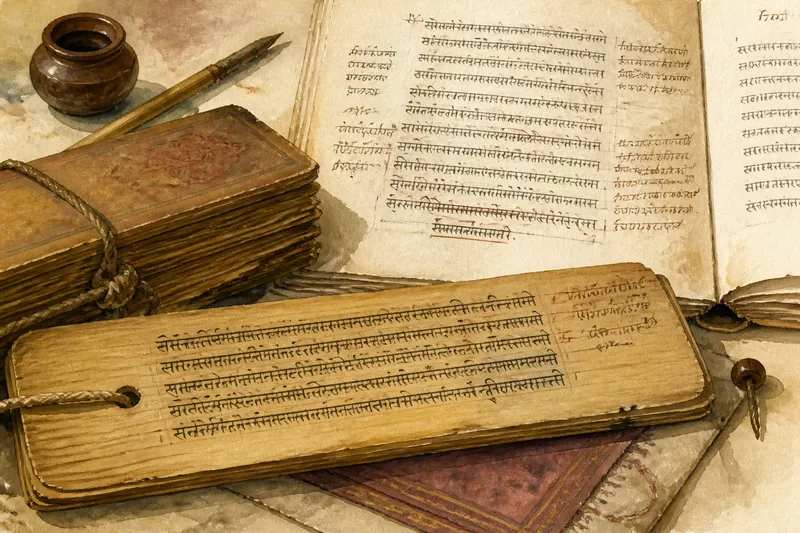
Before a Sanskrit text could travel, someone had to put it on a surface suited to the place and purpose. In South Asia, scribes wrote on materials including palm leaf and paper. The choice affected the page’s shape, the way letters were formed and the care needed to keep the writing legible.
Palm-leaf folios are long and narrow, so lines tend to run across a horizontal strip. A hole and cord could hold a group of leaves together, while covers protected the bundle. Paper allowed different page proportions and methods of binding. Neither surface was merely a container: each shaped how a reader handled, stored and followed the text.
Imagine a scribe copying a ritual passage onto palm leaves for a local teacher. The narrow folios encourage a compact line; a later reader can follow the passage leaf by leaf, while the cord keeps the bundle in order. The words matter, but so do the physical arrangements that make them usable.
Copying preserves a text by remaking it
Hand copying was not mechanical duplication. A scribe read a source, formed each character and made choices when a mark was faint, a line was damaged or a word was unfamiliar. Even a careful copy could differ from its exemplar through a slipped syllable, a repeated phrase, a correction or a change in spelling.
Some variations were inadvertent. Others could reflect a scribe’s effort to clarify a passage or align it with the form familiar to a community. A correction above a line, a crossed-out word or a note in a margin can preserve traces of that work. Such marks are not noise around the text; they help reveal how it was transmitted.
A useful analogy is a recipe copied onto a card for another household. The dish may remain recognisable, while a cook adds a note about a familiar ingredient or corrects an unclear instruction. A manuscript is not a kitchen card, of course, but both show how copying can carry a work forward while leaving evidence of readers’ choices.
People and institutions carry texts between places
Sanskrit manuscripts moved with teachers, students, religious communities, courts and collectors. A teacher might carry a text to a new place; a student might copy it for study; a temple or monastery might keep it for ritual or instruction. A manuscript’s journey need not have been a single, direct passage from one centre to another.
Transmission also depended on more than movement across distance. A text could be learned aloud, consulted in a local collection or copied from a copy that had itself travelled. Oral teaching and written records could support one another: a manuscript might anchor a lesson, while recitation helped readers recognise a missing or troublesome passage.
Say a student takes a teacher’s copy to another town and prepares a new one for a small circle of learners. The new manuscript carries the teaching onward, but its handwriting, annotations and occasional corrections may reflect that circle’s needs. Its history is not simply a route on a map; it is also the relationships that made copying worthwhile.
Differences between copies tell a history
When scholars compare manuscripts of the same work, they look for patterns rather than assuming that the oldest-looking or neatest copy must be the best. One version may preserve a reading that another omits; several copies may share a distinctive error, suggesting a connection in their transmission. A family of related copies can sometimes be inferred from repeated agreements and differences.
This comparison does not always lead to one certain wording. A passage may survive in several credible forms, and the evidence may not settle which came first. Editors can record variants and explain their choices, allowing readers to see where the text is stable and where its history remains open to interpretation.
The aim is not to treat every variation as equally meaningful. A copying slip and a substantial revision are different kinds of evidence. But neither should be dismissed before it is examined: even a small difference can show how a passage was read, remembered or repaired in a particular line of transmission.
Language and script are not the same thing
Sanskrit is a language, while the scripts used to write it have varied by region and period. A Sanskrit text may appear in Devanagari, Grantha, Telugu, Bengali or another script, depending on where and by whom it was copied. The letters on a page therefore provide clues about scribal practice and locality, but they do not by themselves identify the text’s language or original home.
This distinction matters when manuscripts are catalogued or compared. A reader familiar with one script may need training to read another, even where the underlying Sanskrit words are familiar. Transliteration can help people compare forms across scripts, but it does not erase differences in page layout, spelling habits or scribal marks.
A manuscript’s script can change as a text crosses linguistic communities. Readers may preserve the Sanskrit wording while using a script they already know. That choice points to access and use, not necessarily a change in the text’s language.
Readers leave another layer on the page
Manuscripts were read, taught from and consulted, not merely stored. A reader might underline a phrase, add a gloss, mark a passage for recitation or write a brief comment in the margin. Such additions can distinguish a working copy from one made chiefly for display or safekeeping, though a manuscript may serve several roles over time.
Annotations can connect a text to other forms of knowledge. A gloss may explain a difficult word; a note may point to a related passage or clarify how a line is understood. These additions should not automatically be mistaken for part of the original composition. Their placement, handwriting and relation to the main text help readers judge what they are seeing.
For a historian, a page with multiple hands can be especially revealing. It records not just the act of copying but later encounters with the work. A manuscript’s authority may have rested partly on the people who studied and maintained it, rather than on an imagined purity of wording.
Survival depends on care and circumstance
A manuscript’s survival is never a complete record of everything once copied. Materials can wear, insects can damage leaves, and collections can be dispersed or neglected. Local climate, storage and patterns of use all affect what remains. A missing text may have been widely read; a surviving one may owe its presence to an unusual chain of care.
Preservation involves practical decisions. A collection may need to limit handling, support fragile folios and keep a record of repairs. Digital images can make a manuscript easier to consult without repeated physical contact, but they do not replace the object’s thickness, binding, texture or evidence of use. A photograph may show a line clearly while hiding how the leaves were assembled.
When an institution holds a manuscript, its catalogue description and conservation record become part of how later readers encounter it. Those records can identify uncertain readings, damage or earlier repairs. They also remind us that preservation is active work, not a pause in the manuscript’s history.
Questions readers ask about the Sanskrit manuscript tradition?
Does one manuscript give the definitive text?
Not necessarily. A single copy can be valuable evidence, but comparison with other witnesses may reveal omissions, additions or alternative readings. Where no comparison is available, uncertainty should remain visible rather than being filled in by guesswork.
Can the script identify where a text was composed?
It can offer clues about where a particular copy was written or used, but script alone cannot establish where the work first took shape. A text may travel far from its place of composition and be copied in a different regional script.
Are marginal notes part of the Sanskrit work?
Usually they are evidence of later reading, teaching or correction rather than part of the main composition. Their position and handwriting help distinguish them, though some notes may have entered later copies as additions to the text itself.
Why do editors keep track of variant readings?
Variants show how a work moved through generations of copying and use. Recording them lets readers understand editorial decisions and notice where more than one wording has a credible history.
Read the manuscript as both text and object
To follow the long road of the Sanskrit manuscript, keep two questions together: what does the text say, and what does this particular object reveal about its passage through time? The first attends to words and readings; the second to surface, script, binding, corrections and readers’ marks. Neither question is complete on its own.
This approach changes the meaning of preservation. A manuscript tradition did not preserve every work as a flawless object outside history. It carried texts by making new copies, adapting their material form and keeping them in circulation through communities of learning. The Sanskrit manuscript tradition is not a choice between an untouched original and a corrupted copy. It is a record of transmission, in which change can be evidence of the care that allowed a text to endure.