Why Classical Chinese Poems Often Leave the Subject Unsaid
Learn how omitted subjects shape classical Chinese poetry, and how to spot what a translation settles that the original leaves open.
The common mistake with classical Chinese poetry is to supply a person too quickly: “I watch the moon,” “she remembers home,” or “the traveller feels lonely.” That choice can make a line easier to read, but it may also narrow its meaning before the poem has done so. Classical Chinese poems often leave the subject unsaid, asking readers to use nearby words, parallel lines and the scene itself to work out who—or what—is acting.
An omitted subject is not necessarily a missing thought
In English, a complete sentence usually names its subject. “The river moves” gives us an actor and an action. Classical Chinese can present an action or image without naming an actor, and the surrounding lines may not settle the question. A translation that inserts “I”, “he” or “she” therefore makes an interpretive choice, even when the added word sounds natural.
This does not mean the original is defective or that every possible subject fits. The poem supplies other kinds of guidance: a verb, a location, a change in light, a nearby noun, or a pattern shared by two lines. Readers use those cues to form a reading, while recognising where the wording permits more than one.
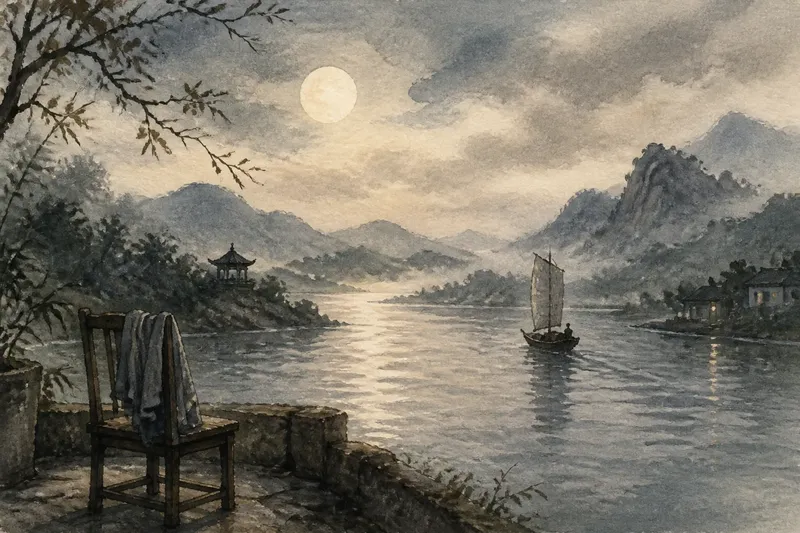
Think of a coat left on a chair. You can tell that someone has been in the room, but the coat alone does not tell you who, when, or why. A poem’s image can work similarly: it gives a reader something definite to see while leaving the human presence less definite.
Context gives an action its likely subject
Start with the words that are present rather than immediately repairing the sentence in English. Ask what the line describes, where it happens, and whether the previous or following line introduces a person, a place, or a point of view. An omitted subject may carry across a line, but that is a possibility to check, not a rule to impose.
Classical Chinese verse also uses compact phrasing and parallel structure. Two lines may place corresponding images or actions side by side. If one line names a traveller and the next describes a distant lamp, the pairing may invite a connection; it does not automatically make the traveller the one looking at the lamp. The relation between images can be meaningful even when the grammar does not spell it out.
Pay attention to what changes. A shift from a private room to a broad landscape may signal a change in viewpoint, or it may widen the same speaker’s attention. A line about an object can stand on its own, too. Not every moon, cloud or river needs to become a disguised statement about a human emotion.
What can a translation make more certain?
English often asks a translator to choose a subject, add a pronoun or connect fragments into a smooth sentence. Those choices can help a poem sound coherent, but they may turn an open relation into a settled one. Compare translations by noticing exactly where one names a speaker and another leaves the action impersonal.
Verb tense and articles can also guide the reader. English may require a choice between “the moon rises” and “a moon rises”, or between a present action and a past one. Such decisions are not automatically mistakes; they are part of making the poem readable in another language. The useful question is whether the translation signals its interpretation or quietly presents it as the only available one.
When you have access to the Chinese text, look for the actual character used for a subject. If a translator supplies “I” but the corresponding line has no first-person pronoun, note that difference. It does not prove the translator is wrong. It tells you where the English has made explicit something the original may leave to context.
How can you read an open subject?
Should I assume the poet is speaking?
No. A poem may invite a personal voice, but an image or action does not by itself identify the speaker. Check for a first-person pronoun, a clear point of view, or a link to an earlier line before treating “I” as certain.
Does an omitted subject mean the line is ambiguous?
It may leave the actor uncertain, but the action, setting or emotional atmosphere can still be clear. Separate what the line plainly presents from the identity you infer.
How can I compare two translations?
Set the versions beside each other and mark added pronouns, tense choices and connections between lines. Then ask whether each version preserves the same images while making different claims about who acts or sees.
Should I prefer the most literal translation?
Literal wording can help you notice what has been supplied, yet it may sound awkward or conceal how the lines relate. Read it alongside a fluent translation, treating each as a different aid rather than a final authority.
A small reading practice keeps possibilities visible
Say you are reading a translated line about a traveller, a river and a receding sail, while the source text does not name who watches. First, underline the visible elements: the traveller, river, sail and motion away. Next, note whether the previous line places a speaker beside the water. If it does, the speaker is a plausible observer; if not, the line may simply set the sail’s departure beside the traveller. Keep both readings in your margin until another cue supports one more strongly.
This is not a puzzle with a hidden answer that every reader must recover. It is a way to distinguish textual evidence from a translator’s helpful addition and from your own response. If the poem’s remaining images support more than one viewpoint, that openness may be part of its effect.
When reading classical Chinese poetry, let the scene arrive before assigning it a speaker. Then return to the translation’s pronouns and ask what each one clarifies—and what it closes off. That small pause makes room for the poem’s objects, actions and silences to carry meaning without forcing them into a single voice.